
Your Messy Sales Pipeline Is a Gift to the IRS. Here’s How to Fix It.
Your Messy Sales Pipeline Is a Gift to the IRS. Here’s How to Fix It.
By Jesse Taylor
Location: Denver, Colorado
What we do: We install automated sales systems for full-time epoxy contractors doing 10–30+ installs/month so leads get answered fast, quotes get followed up, and calendars fill without you living in your inbox. (neverstopagency.com)
Not tax advice. Always confirm specifics with your CPA.
The Year-End Scramble
December is when the “busy” lie gets exposed.
You’re pushing installs before the holidays.
The crew is juggling family stuff.
Suppliers are slow.
Customers want it done yesterday.
And your pipeline?
It’s usually chaos.
Missed calls you meant to return
DMs you forgot to respond to
Quotes half-built in your notes app
Follow-ups that keep getting pushed to “when I get time”
Deposits that should have been collected, but weren’t
I work with epoxy contractors who are already doing real volume.
They’re not broke.
They’re not lazy.
They’re overloaded.
And here’s the part nobody talks about:
A messy pipeline doesn’t just cost you jobs.
It forces a year-end choice you do not want to make.
Either:
You watch revenue leak out and finish the year frustrated.
OrYou finish the year with profit sitting there, and Uncle Sam gets his cut because you didn’t reinvest into infrastructure that actually fixes the leak.
Your pipeline becomes a donation box.
Your Leaky Pipeline Isn’t Just Lost Profit. It Creates a Tax Problem.
Let’s be precise.
You don’t “pay taxes on money you never made.”
But you do pay taxes on profit you keep, instead of reinvesting into legitimate business expenses that strengthen your operation.
The IRS standard you’ll hear over and over is “ordinary and necessary.”
Ordinary means common and accepted in your industry.
Necessary means helpful and appropriate for your business.
So when your pipeline is messy, here’s what happens in real life:
You leak revenue you should have captured
Calls go unanswered
Leads get cold
Quotes go stale
Follow-up gets inconsistent
Customers buy from the contractor who responds first
You compensate by buying more leads
That does not fix the root problem.
It just pours more water into a leaking bucket.
Then year-end hits
Now you’re staring at your numbers thinking:
“Do I just pay the tax bill?”
Or
“Do I reinvest in something real that makes next year easier?”
That’s the reframe.
A sales system is not a “nice-to-have.”
It’s how you stop bleeding money.
And how you stop finishing every year with the same panic and guesswork.
You Don’t Need Better Floors. You Need a Better Workflow.
This is the truth I wish every contractor would accept faster:
Your installs are probably not the problem.
If you’re doing 10–30+ jobs/month, you already know how to deliver.
Your bottleneck is the space between:
New Lead → Paid Job
That’s why my team and I focus on workflow, not “more marketing.”
We work with full-time epoxy contractors doing 10–30+ installs/month who already have lead flow.
The problem is rarely lead volume.
It’s what happens after the lead raises their hand.
And speed matters more than most people want to admit.
Speed-to-lead is not a motivational concept. It’s math.
Research has shown response speed drops your odds fast.
MIT-backed lead response research shows the odds of contacting a lead can drop dramatically when response time moves from 5 minutes to 30 minutes.
Harvard Business Review has also highlighted how short the “life” of an online lead is and how slow response hurts outcomes. (
If you’re on a grinder and miss a call, that lead is not “waiting patiently.”
They’re calling the next guy.
This is why we build systems that respond in seconds and keep following up until the deal is closed or closed out.
Not spam.
Not cringe.
Just professional follow-through.
Real example from the field
We worked with a contractor who was already doing good work.
They were stuck in a “quote and hope” cycle.
They’d send proposals… then wait.
No structure.
No follow-up.
No visibility.
After we tightened the workflow, they went from roughly $40K months to $92K+ months on flake floors alone.
Same crew.
No extra hours.
No late-night chasing.
Not because their floors got better.
Because their workflow stopped bleeding.
Systematize the Process, Not the Person
A lot of owners hear “system” and think:
“I don’t want to sound robotic.”
“I don’t want to lose the personal touch.”
“I don’t want my business to feel like a call center.”
Good.
That’s not what we build.
A good system does not replace you.
It replaces the parts of your sales process that should never depend on:
your memory
your mood
your free time
whether you’re covered in epoxy dust
The system handles the predictable parts:
Respond to every lead in seconds
Pre-qualify and filter out the “$4 per sq ft” crowd
Book on-site estimates straight into your calendar
Follow up on every quote until it’s closed or closed out
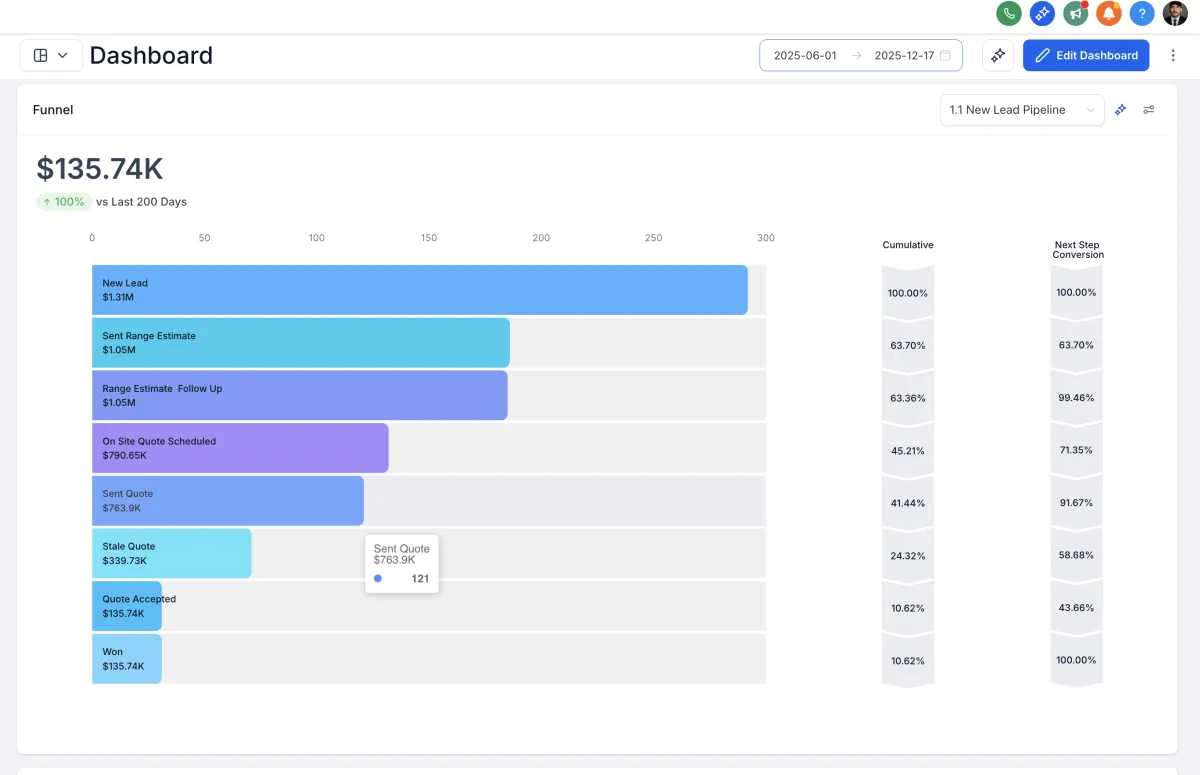
Show a scoreboard so you can see stuck money
You still do the human parts:
show up
build trust
walk the job
make recommendations
close
collect the deposit
lead production
The system builds the machine.
You run the jobs.
The Workflow That Fixes Most Epoxy Pipelines
If your goal is consistent revenue without chaos, you need 6 things working together.
1) One pipeline. One source of truth.
Not sticky notes.
Not “my wife has it.”
Not a DM thread.
Every lead goes into one pipeline.
If you can’t see it, you can’t close it.
Minimum stages:
New Lead
Contacted
Qualified
On-Site Booked
Quote Sent
Follow-Up Needed
Won
Lost / Closed Out
The labels don’t matter.
The discipline does.
2) Speed-to-lead automation (so you stop losing the “first vendor wins” game)
Rule:
If a lead comes in and hears nothing for an hour, you already lost.
What we install:
Missed call → instant text
Form submit → instant text
FB lead → instant text
Then follow-ups queued if they don’t reply
Simple language.
Clear next step.
Example text (contractor tone, not corporate):
“Hey, just missed you. Want a quick price range over text, or do you want to book a 10-minute call?”
This one piece alone changes your contact rate because it removes the “I’ll call them later” lie.
3) A fork in the road: auto-quote range vs on-site
Not every lead deserves an on-site.
Your process should route based on:
scope
square footage
condition
urgency
budget signals
Path A: Auto-Quote Range
Collect basics fast
Send a realistic range
Push them to the next step if it fits
Path B: On-Site
Book it
Confirm it
Pre-frame expectations
Show up with authority
This protects your time.
And it filters tire-kickers without you arguing with them.
4) Quote follow-up that is scheduled, not emotional
Most contractors follow up based on vibes.
If they “feel weird,” they don’t follow up.
That’s how quotes die.
Better rule:
Follow-up is a process.
Not a personality trait.
A clean follow-up cadence (example):
Day 0: “Sent. Want me to walk you through it?”
Day 1: “Any questions before you decide?”
Day 3: “Do you want Option A or B?”
Day 7: “Do you want this done this month or next?”
Day 14: “I’m closing out open quotes Friday. Still want a spot?”
Notice what’s not in there:
“Just checking in.”
Every message creates a decision.
5) Stale quote recovery (this is where hidden money lives)
Most epoxy businesses have a “quote graveyard.”
Weeks of quotes sitting there.
That’s not “lost.”
That’s neglected.
Your system should trigger reactivation at:
14 days
30 days
60 days
And it should be framed like a business owner, not a desperate salesperson:
“Quick one. I’m cleaning up my schedule. Still want to knock this out, or should I close your file?”
That question gets replies because it forces closure.
6) Weekly scoreboard (so you stop guessing)
Once a week, you should know:
leads received
leads contacted
appointments booked
quotes sent
deals won
deals stuck
oldest quote not resolved
If you don’t track these, you’re running your company off emotion.
Emotion is expensive.

The Year-End Move That Actually Makes Sense
If you’re reading this near year-end, do this in order.
Step 1: Re-open every quote from the last 60 days
Call them.
Text them.
Close the loop.
Not forever.
Just once.
You’ll be shocked how often you hear:
“Yeah, we still want to do it. We just got busy.”
Step 2: Install speed-to-lead and follow-up first
Before you buy more leads.
Because research consistently shows speed matters.
Step 3: Ask your CPA the right question
Not “Can I write this off?”
Ask:
“If I reinvest profit into ordinary and necessary business infrastructure, how does that impact taxable income this year?”
Conclusion: Stop the Bleeding
Every year you leave money in the cracks, you’re making a decision.
Not a moral decision.
A workflow decision.
You’re not stuck because of your work ethic.
You’re stuck because of your workflow.
Fix the workflow and you get:
faster responses
fewer ghosted quotes
more booked installs
predictable weeks
less stress
a business that stops collapsing every time you touch a grinder
If you want to scale, stop chasing.
Start systemizing.
Question for you: What is the real cost of every quote you let sit, and every follow-up you keep pushing to “when you get time”?
Author
Jesse Taylor is the founder of Never Stop Agency, a backend growth partner that installs automated sales systems for full-time epoxy and concrete coating contractors. He helps contractors turn chaotic leads and quotes into a simple sales workflow that responds in seconds, filters tire-kickers, books on-site estimates, and follows up until every quote is resolved.


